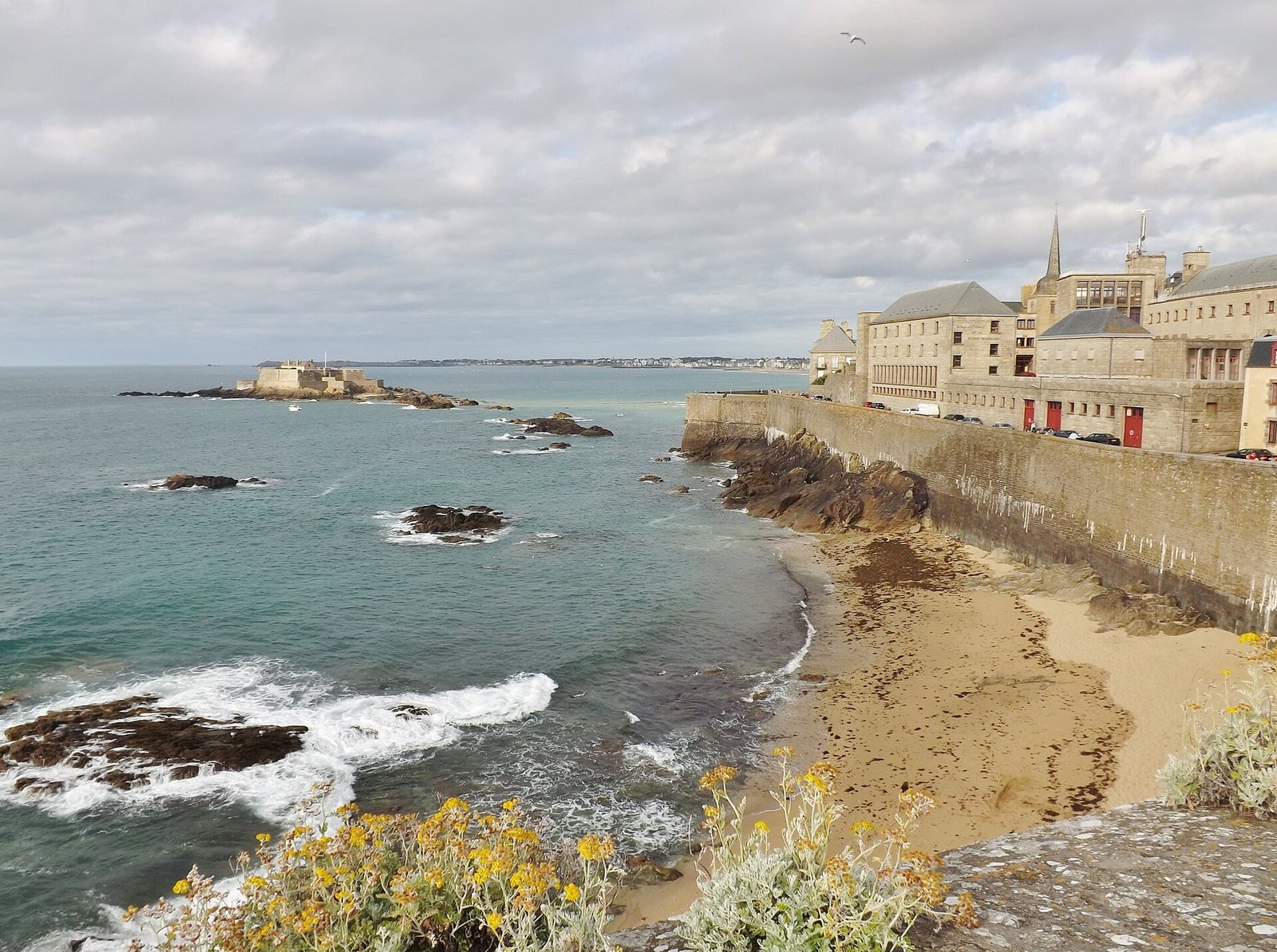
Saint-Malo has something few cities possess: it commands respect before you even enter. Those grey ramparts pounded by Europe's biggest tides — up to 13 metres of range at the equinoxes —, that fortress silhouette set on the sea, that corsair past of ransoming England with the King's blessing... The Malouin city is not visited, it is boarded. Here is our battle plan for a weekend on the Emerald Coast.
First, understand the tides (everything depends on them)
In Saint-Malo, the tide is the true master of schedules. At low tide you walk to the Grand Bé — where Chateaubriand rests facing the open sea, as he demanded — and to the Fort National. At high tide the same islets become unreachable again, and beware the distracted: every year visitors get trapped by the rising water. Check the timetables (posted all over town) and, if you can, aim for a coefficient above 100: the spectacle of waves exploding over the Sillon sea wall is then one of France's great free shows.
Intra-muros: ramparts first, lanes second
Start with the full circuit of the ramparts — 2 kilometres, an easy hour, free and always open. It is the best summary of the town: the beaches revealing themselves, Vauban's forts, the shipowners' mansions, and that sea changing colour every ten minutes. Then drop into the lanes: Saint-Vincent cathedral and the tomb of Jacques Cartier (the Malouin who "discovered" Canada), the shops of Rue de l'Orme, and a crêperie — the true local test: buckwheat galette complète + a bowl of farm cider, €12–16.
A confession: intra-muros was rebuilt identically after 1944 — 80% of the city had burned. You cannot tell anywhere, and it may be the finest town-planning lesson of the post-war era.
Cancale: oysters at the kiosk, a ritual
Twenty minutes away, Cancale is France's oyster capital — and its oyster market on the La Houle harbour is a ritual we never skip: a dozen no. 3 oysters for €7–9, a lemon, tasting on the jetty facing Mont-Saint-Michel floating on the horizon, and the shells tossed onto the shore as everyone has done for generations. One of French gastronomy's best pleasure-to-price ratios.
Dinard, the Belle Époque mirror
Facing Saint-Malo — a 10-minute ferry, and the crossing alone is worth the ticket —, Dinard lines up 400 listed villas above its beaches. Wealthy 19th-century English invented Breton seaside tourism here, and the palm-planted Clair de Lune promenade (the Gulf Stream works miracles) remains one of France's most elegant. Push on to the Pointe du Décollé along the customs officers' path.
Cap Fréhel and Fort La Latte: the grand finale
Forty minutes west, Cap Fréhel raises its pink sandstone cliffs 70 metres above an emerald sea — the coast's name earns itself here. Allow 1.5 hours of coastal path to Fort La Latte, a castle set on its rocky spur (dozens of films were shot there; you quickly see why). On clear days the view reaches Jersey.
The editors' tip: sleeping intra-muros is an experience, but rooms are small, pricey and quickly full. Our alternative: Saint-Servan, Saint-Malo's southern quarter — the Solidor tower, a pocket harbour, family-run addresses — 20 minutes' walk from the ramparts and 30% cheaper. Our accommodation picks are on the Saint-Malo page.
Practical info
- Access: direct TGV Paris-Saint-Malo in 2h15 — one of the great weekend rail escapes.
- When: June and September for the best light-to-crowds ratio. The equinox spring tides (March, September) deserve a dedicated trip. Stormy winter has its devotees — we are among them.
- At the table: Cancale oysters, galettes, kouign-amann (the real one, dripping with butter), and Bordier butter people travel for.
And if the weekend stretches, Mont-Saint-Michel is 50 minutes away — but that is another story, and it deserves its own guide.
The mistakes to avoid
- Ignoring the tide calendar. It is THE trip parameter: Grand Bé access, the Sillon show, shellfish gathering — everything depends on it. Every year visitors get trapped on the islets by the rising tide.
- Never leaving intra-muros. The walled city is superb but small; Cancale, Dinard and Cap Fréhel are half the magic.
- Eating oysters in a restaurant. At the Cancale harbour kiosk, a dozen costs €7-9 facing Mont-Saint-Michel. In a restaurant, the same dozen tops €20. Quick decision.
- Coming in July-August without a booking. Intra-muros sells out weeks ahead and the car parks overflow by 10am.
- Parking inside the walls. Spaces are scarce and dear. The Paul Féval or Talards car parks + shuttle/walk save time, money and nerves.
Weekend budget for two
| Item (2 nights) | Budget | Comfort |
|---|---|---|
| Hotel (Saint-Servan / intra-muros) | €150-220 | €260-400 |
| Meals (crêperies + one fish dinner) | €110-150 | €180-260 |
| Cancale oysters + kouign-amann | €20-30 | €30-50 |
| Dinard ferry + visits | €25-40 | €40-70 |
| Total | ~€305-440 | ~€510-780 |
Where to stay: the editors' shortlist
- The smart move: Saint-Servan, 20 minutes' walk from the ramparts — Solidor tower, pocket harbour, 30% less than intra-muros.
- All our addresses: on the Saint-Malo page.
Frequently asked questions
When are the great tides?
Around the equinoxes, in March and September, when coefficients exceed 100-110. Exact dates are on any tide calendar — book early; photographers worldwide have the same idea.
How many days for Saint-Malo and its region?
Two days for the city + Cancale + Dinard; three to add Cap Fréhel and Fort La Latte. Beyond that, Mont-Saint-Michel (50 minutes) and medieval Dinan naturally extend the trip.
Can you combine Saint-Malo and Mont-Saint-Michel?
Easily: 50 minutes by road, or a direct seasonal bus. Our advice: sleep in Saint-Malo and visit the Mont early morning or late day — between 11am and 4pm its Grande Rue is a metro corridor.
Where to park for the walled city?
At the Paul Féval (free shuttle) or Talards car parks (10 minutes' walk), €5-8 a day versus double inside — when space remains. In summer it is the only reasonable plan.
Is swimming pleasant?
Breton water peaks at 17-19°C in summer — invigorating, say the locals. The Sillon and Bon-Secours beaches (with its seawater pool refilled at high tide) are superb; bathing there is a badge of honour more than a comfort.
Photo: "Remparts de Saint-Malo depuis Tour Bidouane", Wikimedia Commons, CC BY-SA 3.0 licence.


